
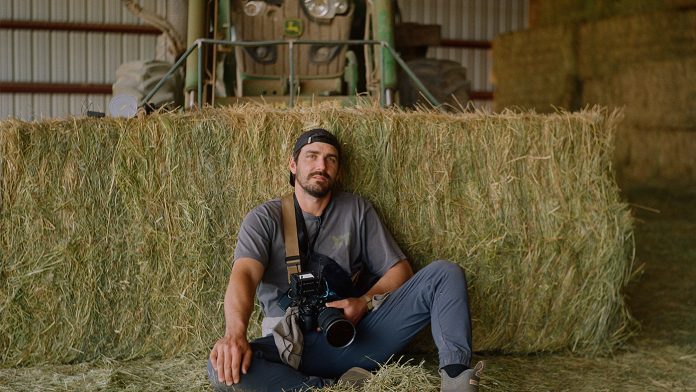
Photographer Forrest Mankins mentioned to OWC that he was so buried in commercial work he rarely shot for himself anymore. Rather than hand him a deliverables list, the company handed him the reins. “They said they’d like to do something I was excited about,” Mankins says. That conversation led to “Personal Work,” a series built around the idea that a shoot can still feel like a road trip with your friends.
The show’s thesis lives in one line Mankins has repeated through prepro, production and post. We can take the work seriously without taking ourselves too seriously. He sees the opposite everywhere online. “A lot of the stuff you see online is people shooting what they think they should be shooting, instead of leaning into what really interests them,” he says. He’s done it himself. The correction is a question he keeps asking himself. What do you actually want to make?
The entire crew fits in one truck
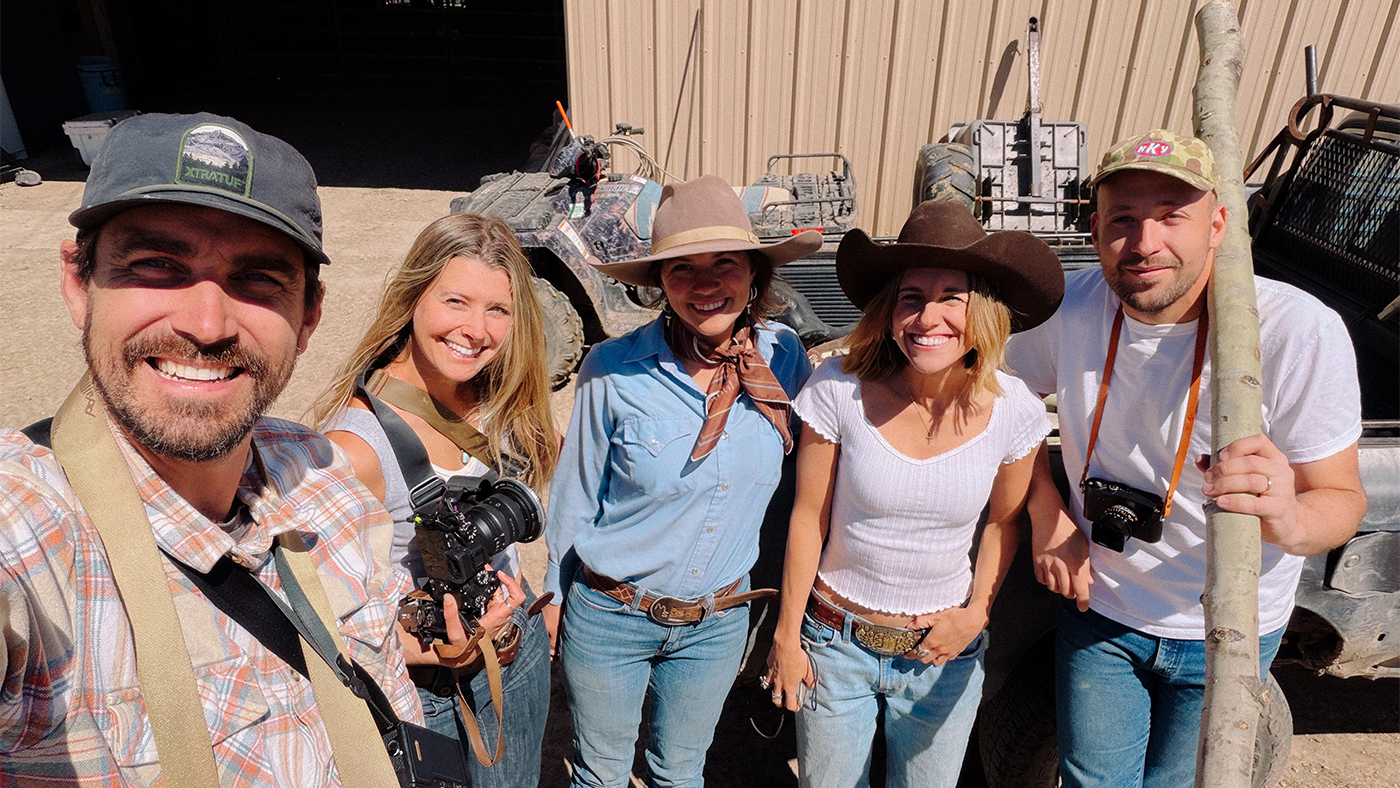
The team is Mankins, filmmaker Julien Jarry and photographer Kelly Jarry. Three people. No producer, no DIT, no second unit, no van full of grip.
Ask Julien which production roles he’s absorbing and the answer comes fast. All of them, minus B camera and AC, because Kelly covers those. “The ones that probably take up the most time and brain power are producer, director and DIT,” he says. “It’s a one-man band type of situation.”
The arrangement took adjusting. Julien admits there was friction early on, though it was mostly internal. His expectations didn’t match what the show wanted to be. “Once I embraced the reality of what we were doing and stopped trying to turn it into something that it wasn’t, things just flowed.”
Past that, the division of labor sorts itself out naturally. Mankins brings the locations, since the episodes wander through corners of his own world. Julien works out the intros and talking bits with him in advance, then again on the day. Kelly walks roughly 50,000 steps per shoot day and comes back with a volume of compositions Mankins still finds astonishing. The Jarrys also show up with groceries and cook. Nobody asked them to.
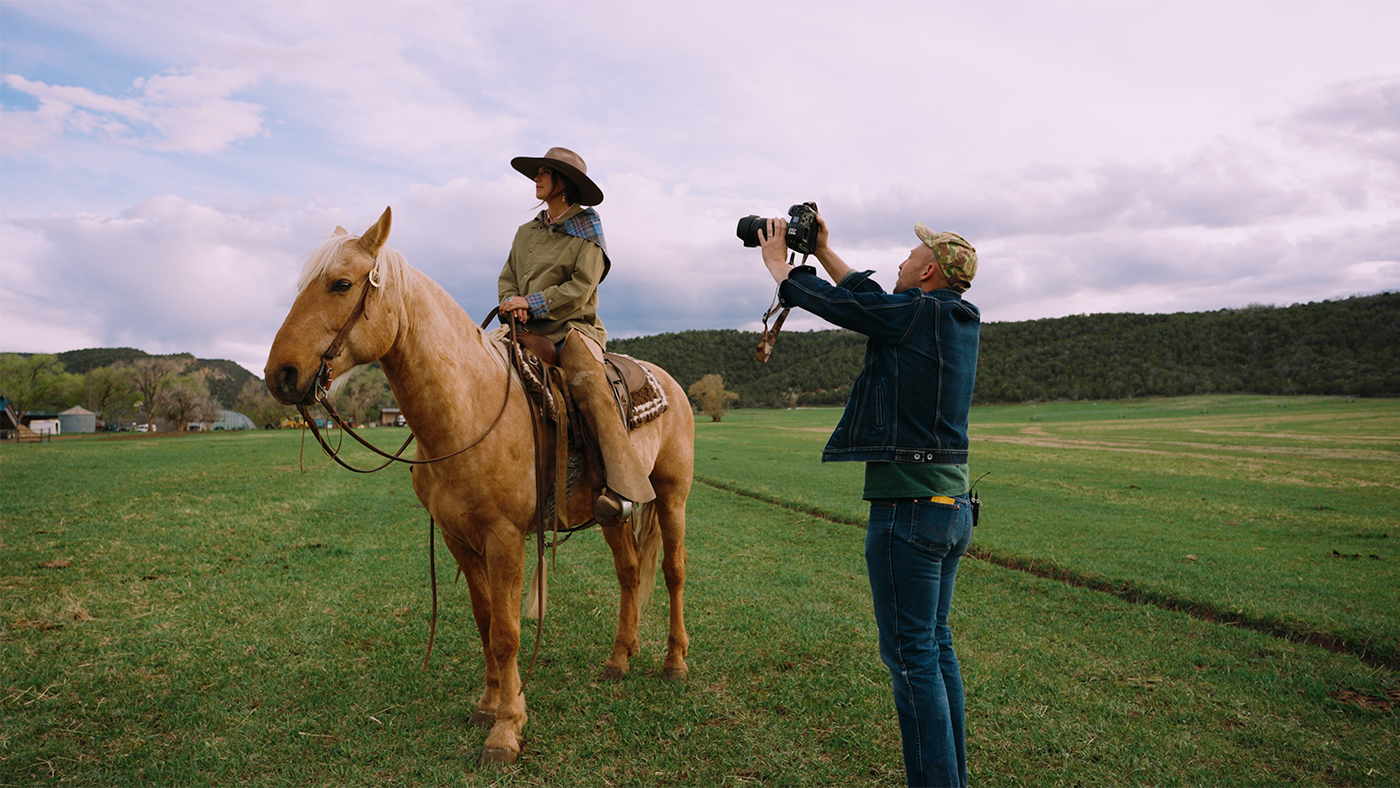
Big crews leave less room for accidents
Mankins has worked the other way, and he doesn’t miss it. “I used to feel like a real badass being the photographer on a set of 60 people,” he says. He could still do it. It just sounds like a drag now.
His argument against the big footprint isn’t logistical. It’s creative. When a production is held that tightly, everyone works so hard at their assigned role that nothing unplanned survives the day. “There is no room for a happy accident,” he says. “You lose the individuality and humanity.”
What replaces it is play. Not ease. The weather still turns and the days still run long. Play is the mental state where you have room to try something, to be yourself, to make something memorable maybe. That mostly doesn’t happen. The possibility just has to be on the table.
Episodes still get planned, partly for scheduling and partly for self-preservation. “They have to be planned to an extent or else I’ll ADHD my way into oblivion and start talking about cameras I wish I’d never sold,” Mankins says.
The gear setups
Both men have landed in the same place on gear, from opposite directions.
Mankins shoots digital on an R5 with a 28-70mm f/2, and that’s the whole kit. He’s made 95% of his work on a Canon full-frame body and a midrange zoom. His film setup is a Hasselblad with an 80mm and Portra 800. More gear than that and he says he turns into a scatterbrain on the day.
“Personal Work” runs on a pair of Sony A1 II bodies. Julien carries the 28-70mm f/2 GM and stays wide at 28mm. Kelly runs the 24-70mm f/2.8 GM II and keeps it long, generally between 50mm and 70mm. Two operators, two usable angles on every setup, no third body required. Cutaways are whatever catches either of them.
For Julien, that’s a deliberate step down from where he used to be. He now takes an A7R V, A1 or A1 II on jobs that once demanded an FX6 or a Red. Those cameras still have their place. He keeps reaching for the hybrid mirrorless anyway. “The camera doesn’t matter,” he says. “It’s the light, location, atmosphere, subject.”
Mankins puts the goal more bluntly. “Nothing is as boring as a full-frame camera like the A1 II or R1 with a 28-70 lens,” he says, and that’s the point. The equipment works. You never think about it. “If you’re out in the world and thinking about your equipment, you’re chopped.”
The 3-2-1 setup that saved a commercial day
Here’s the part that most three-person productions get wrong.
Julien shoots simultaneously to both card slots on every body, using 960GB OWC Atlas cards. Two matching cameras, shotgun mounts, four cards total. The redundancy is automatic, and the capacity means he isn’t formatting between setups. Some shoots run their entire length without a single card swap.
Mankins runs the same logic at a larger scale. Like most people, he lost years of digital photos before he ever went pro. New phone, old big-box hard drive, time marches on. So he bought fully into 3-2-1. A 2TB card lives permanently in his R1 alongside a 1TB in the second slot. On the road, one copy lands on his 8TB MacBook Pro. Two or three 4TB SSDs each get a copy, and if he’s leaving the truck in a city, one of those goes in his pocket.
It sounds excessive until you’ve shot in bad conditions for ten years. It also has a receipt. The first 2TB OWC card he was sent covered a full week of shooting with room left over, then salvaged a commercial day after 16 hours of stills and video ended in one wrong move on the computer. “I almost lost everything,” he says.
At home, the copies keep multiplying. Mankins works off the desktop, backs up immediately to a ThunderBay 8 and mirrors to a large spinning drive. Every year another spinning drive goes to his mom’s house in Oklahoma. Julien’s version is leaner. He dumps cards to OWC Elektron SSDs, ships one out as a shuttle drive to the editor and archives to his own ThunderBay 8 once he’s home.
Storage is the least glamorous line item on any budget. On a three-person show with no post team, it’s the only insurance policy anybody has.
Looking forward
Neither of them frames this as a gear story, and they’re right.
Mankins wants to point the series toward Alaska, toward people living deliberately outside the noise. He wants to photograph them with respect and humor. What he’s protecting as it grows is candor. Julien wants the version of a career where the client says do whatever you want. “The goal is to not have any clients,” he says. “You’re just out there free making what you want, and people just happen to want to pay you for that work.”
The permission structure is available to anyone reading this. Shoot the thing you’re actually interested in, Mankins says, the way you’d shoot it if you were the last person on earth. Then back it up five times.
You can learn more about OWC’s library of storage solutions at OWC.com.

