
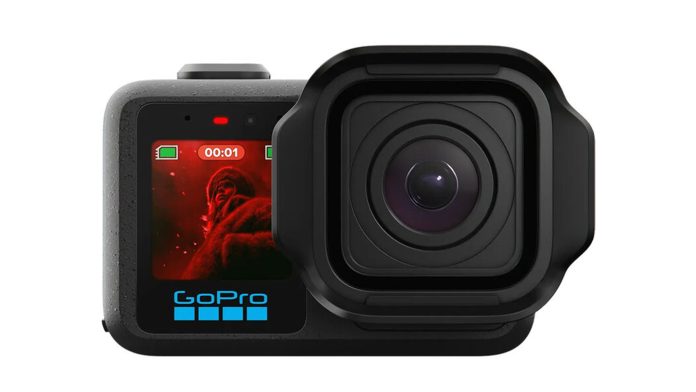
GoPro has spent the past several years refining the HERO line. Some generations brought meaningful upgrades. Others felt like GoPro was tightening a product that already worked, which isn’t necessarily a bad thing. A mature camera line doesn’t need to be rebuilt every year.
Still, action camera users have had a fair question for a while: When does an upgrade stop being enough?
That question sits at the center of the GoPro MISSION 1 Pro. This isn’t another HERO Black with a new number on the front. GoPro is positioning the MISSION 1 series as a new compact cinematic camera system aimed at filmmakers and serious creators. It’s a big claim, and it needs to be tested rather than accepted at face value.
In our HERO10 Black review, we said GoPro did not “reinvent the wheel.” Instead, the camera offered incremental improvements that added up to a worthy new flagship. That pattern held in the years that followed. By our HERO13 Black review, we noted that GoPro had fallen into the rut of “if it’s not broke, don’t fix it.” The HERO13 Black was still one of the best action cameras available, but the year-over-year upgrades were relatively modest.
The MISSION 1 Pro feels different.
At its core is a new 50-megapixel Type 1 sensor, commonly called a 1-inch sensor, paired with GoPro’s new GP3 processor. Video tops out at 8K and 60 frames per second. You also get 4K at 240 fps plus 8K Open Gate at 30 fps. On the stills side, it shoots 50MP RAW photos. A limited-duration Burst Slo-Mo mode reaches 960 fps at 1080p. On paper, this is the biggest swing GoPro has taken in years.
What is the GoPro MISSION 1 Pro?
The MISSION 1 Pro is part of GoPro’s new MISSION 1 series, which consists of the MISSION 1, MISSION 1 Pro and MISSION 1 Pro ILS. The first two use fixed wide-angle lenses. The ILS swaps in an interchangeable Micro Four Thirds lens mount. It reached GoPro.com and retailers on Sept. 2, 2026, a few weeks after the fixed-lens models. We tested the fixed-lens MISSION 1 Pro for this review.
GoPro isn’t simply making another action camera here. It’s trying to create a new category within its own ecosystem. The HERO Black remains the traditional action camera. The MISSION 1 Pro is aimed at people who need a small camera with better image quality and more professional recording options: filmmakers, commercial shooters, YouTubers, documentary producers, travel creators and production teams.
That makes sense. GoPros are routinely used as B cameras, crash cams and point-of-view cameras. They go on vehicles and into spots where a larger camera simply won’t fit. The drawback has always been matching that footage with higher-end production cameras. A GoPro shot can be exciting, but it can also look unmistakably like a GoPro shot.
The MISSION 1 Pro doesn’t eliminate that completely. It’s still a fixed-lens, ultra-wide compact camera. It does close the image-quality gap enough to make it much easier to cut into a professional production, which may be the most important thing about it.
Design and handling
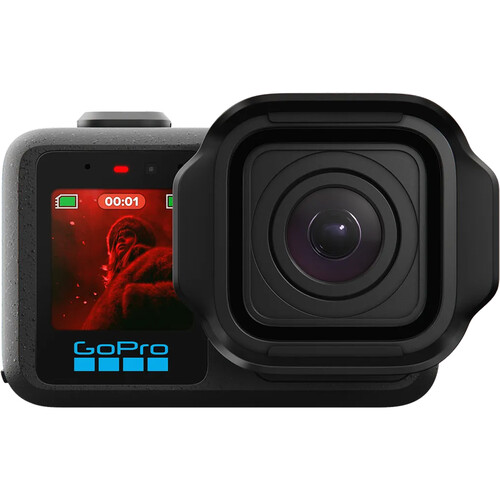
The MISSION 1 Pro is still recognizably a GoPro. It’s compact, rugged and easy to mount. It feels like a camera built to be used rather than babied, which matters because much of its value comes from where it can go.
It’s also noticeably bigger. The MISSION 1 Pro weighs 207 grams with its battery and mounting hardware, compared with 159 grams for the HERO13 Black. The body is wider and deeper around the lens, too. You won’t notice much handheld or on a solid mount. On helmets, extension poles and suction mounts, where every gram counts, it becomes a real consideration.
Waterproofing gets a big bump. The MISSION 1 Pro is rated to 66 feet, or 20 meters, without a housing. That doubles the HERO13 Black’s 33-foot rating and makes the camera especially interesting for underwater work.
The rear display is now a 2.59-inch OLED touchscreen. A 1.4-inch display remains on the front.
Experienced GoPro users won’t feel lost in the interface. The menus are still built around getting the camera configured quickly in the field. This camera may lean toward professionals, but it still needs to behave like a GoPro. If it gets in the way, it loses one of GoPro’s biggest strengths.
Mounting is flexible. Alongside GoPro’s folding mounting fingers, you get a 1/4-20 thread and support for GoPro’s magnetic mounting system. That broad ecosystem remains a major advantage, since the camera is only part of the equation. Mounts, grips and housings can matter just as much. So can batteries, ND filters, audio tools and power options.
The Type 1 sensor is the real upgrade
The most important hardware change is the new Type 1 sensor. Despite the “1-inch” nickname, it isn’t literally one inch across. The imaging area is roughly 13.2 by 8.8 mm. What matters is that it’s substantially larger than the sensors in recent HERO Black cameras.
For years, GoPro has pulled impressive performance from relatively small sensors. Stabilization, frame rates, color and resolution all improved. Low-light performance and dynamic range were where the small sensor kept showing its limits.
The MISSION 1 Pro makes a noticeable improvement here. In bright daylight, the footage is sharp, detailed and clean, but that’s expected. Most modern action cameras look good with plenty of light. The real test is what happens when the light gets difficult.
We shot the MISSION 1 Pro in bright sun, shade and mixed indoor light. We also took it out at dusk and after dark. It handled contrast better than any HERO camera we’ve used. Highlights were less likely to clip harshly, and shadows held more useful detail. It still doesn’t behave like a larger-sensor mirrorless or cinema camera paired with fast glass. Physics hasn’t disappeared. It is, however, a clear step past the traditional HERO look.
Low light is where the difference is easiest to see. Older GoPros could capture scenes after sunset, but noise reduction, sharpening and limited light gathering quickly made the footage look rough. The MISSION 1 Pro produces a cleaner, more natural image in those conditions.
Keep your expectations realistic. This isn’t a night-vision camera, and it wouldn’t be our first choice for a controlled low-light production. Footage from marginal lighting is far more usable, though.
Image quality
The MISSION 1 Pro records 8K 16:9 video at up to 60 fps. Using the sensor’s 4:3 area, it also records 8K Open Gate at up to 30 fps, with a 4:3 Open Gate mode available at 4K120 as well.
Open Gate is one of the camera’s best features. Capturing a taller 4:3 frame gives editors more room to reposition the image after the shoot, so a single clip adapts more easily to 16:9, vertical or other aspect ratios.
That matters more today than it did a few years ago. Most creators no longer deliver one version of a video. A single production may need a horizontal YouTube cut and a vertical Reel. Then come the TikTok version and a handful of client cutdowns. Open Gate lets editors make those calls in post rather than locking everything in on set.
We liked the flexibility of the HERO11 Black’s taller 8:7 sensor, which gave creators considerably more freedom to reframe footage. The MISSION 1 Pro takes that basic idea in another direction by pairing a larger sensor with much higher resolution.
The 8K footage holds a huge amount of detail. That doesn’t mean everyone should shoot 8K all the time. The files are much larger, so you’ll need more storage and processing power to edit them. The highest resolutions and frame rates also drain the battery faster and generate more heat. Still, 8K earns its keep when a shot needs to be cropped, stabilized or reframed. It’s also handy for high-resolution frame grabs.
Bit rates go up to 240 Mbps. Add 10-bit recording and GP-Log2, and experienced users get considerably more control in post.
For many shooters, 4K will remain the sweet spot. It’s easier to store and easier to edit. It still looks very good. In our testing, 4K footage from the MISSION 1 Pro showed better detail, contrast and color than we’re used to from older GoPros. The image keeps GoPro’s wide-angle character but feels less brittle and less aggressively processed.
Skin tones looked better than expected from a camera this small. Greens and blues were strong without turning cartoonish. In high-contrast scenes, the camera did a good job protecting the image, although careful exposure still produced the best results.
More resolution helps. The bigger story is that the image coming off those pixels is simply better.
Dynamic range and low light
Dynamic range is one of the clearest differences between the MISSION 1 Pro and older GoPros. We tested scenes with bright skies and shaded foregrounds. We also threw reflective surfaces and backlit subjects at it. The MISSION 1 Pro handled all of them better than previous HERO cameras.
Highlights can still clip, so exposure still matters. The camera just gives you more room to work. Clouds retained more texture. Shadows held together better. Bright backgrounds were easier to manage without sacrificing the foreground.
Low-light performance impressed us, too. In dim interiors and after sunset, the image was cleaner than we’re used to from GoPro. Noise was still present but less distracting, and the footage kept enough detail to stay useful.
Part of that improvement comes from the larger sensor, which can collect more light under comparable conditions. Sensor design, processing, lens aperture and exposure settings all contribute, too. On the processing side, GoPro added dedicated Low Light capture modes. The GP3 processor also has significantly more processing power than the GP2 in recent HERO Black models.
We’d still choose a larger camera and faster lens for a controlled low-light scene. When a small, rugged camera has to survive a difficult environment and still return usable footage, though, the MISSION 1 Pro raises the ceiling considerably.
Slow motion
GoPro has long been strong in slow motion. The HERO10 Black was a significant step forward because its GP2 processor enabled 5.3K60, 4K120 and 2.7K240 recording. Those frame rates were a big part of what made the HERO10 compelling at the time.
The MISSION 1 Pro goes much further. It records 4K at up to 240 fps, which gives you 8x slow motion on a 30 fps timeline. It also records 1080p and 1440p at up to 480 fps.
Then there’s Burst Slo-Mo. For short moments, the MISSION 1 Pro captures 1080p at 960 fps for up to 32x slow motion. Each burst is limited to 10 seconds, so this isn’t a setting for continuous recording.
Slow motion was one of the most enjoyable parts of testing. Water and dirt look great at these frame rates. So do spinning wheels, hands and tools. The stronger overall image also gives those shots more polish than we’re used to seeing from a GoPro.
There are trade-offs. Very high frame rates need plenty of light because each frame gets less exposure time. That makes the most extreme modes much less useful in dim environments.
Think of the slow-motion options as different tools rather than one headline spec. 4K120 and 4K240 are genuinely useful production modes. The 480 and 960 fps options are more specialized. When the subject and lighting are right, they can deliver shots that would normally require much larger, considerably more expensive high-speed gear.
Stabilization
Stabilization remains one of GoPro’s biggest advantages. The MISSION 1 Pro uses GoPro’s HyperSmooth electronic stabilization and supports 360-degree Horizon Lock in compatible modes.
We tested it handheld and while walking. We also mounted it to a vehicle and pushed it through faster movement. Stabilization was excellent. It smoothed motion effectively and saved shots that would have been difficult with a less capable camera.
In our HERO13 Black review, we called HyperSmooth 6.0 impressive. The MISSION 1 Pro keeps that strength, although GoPro doesn’t use the numbered HyperSmooth branding for the MISSION system.
Digital stabilization needs some room around the recorded frame to compensate for motion, so there’s a crop. The higher-resolution sensor gives GoPro more image area to work with, which makes that compromise easier to accept.
For many creators, the combination matters more than either spec on its own. Better image quality is useful. Pair it with GoPro’s stabilization, and you have a camera you can mount in rough environments with a strong chance of getting footage that fits a professional edit.
Battery life and heat
Battery life and heat have been recurring concerns with high-performance action cameras. The HERO10 Black pushed resolution and frame rates forward, but those modes put heavy demands on its battery and thermal system. The HERO12 Black made substantial progress. GoPro rated it for 70 minutes of continuous recording at 5.3K60, roughly double the HERO11 Black’s rated runtime in that mode.
The MISSION 1 Pro takes another step. It uses a 2,150mAh Enduro 2 battery, up from the HERO13 Black’s 1,900mAh Enduro battery. GoPro rates the MISSION 1 series for more than three hours at 4K30 and about 90 minutes at 8K30. In Endurance mode, it’s rated for as much as five hours at 1080p30.
Those are manufacturer figures. Real-world results will vary with resolution, frame rate, stabilization, screen use and ambient temperature. In our testing, battery performance was strong for a camera with these specs. Higher-resolution and high-frame-rate modes drained power faster, as expected, but the camera felt more predictable than some earlier GoPros.
Thermal performance was good in the conditions we tested. During longer recording sessions indoors and outdoors, the camera got warm but behaved predictably. A high-performance camera doesn’t need to stay cool to the touch. It needs to keep recording reliably within its operating limits.
Be realistic, though. Recording 8K or running high frame rates creates a tough thermal environment for any compact camera. Direct summer sun makes it tougher. If a mode will be used for a long, critical take, test that exact setup beforehand. For production work, predictability matters more than a best-case runtime figure. Even with the bigger battery, carrying a spare remains good practice.
Audio
Audio isn’t usually the first reason someone buys a GoPro. On the MISSION 1 Pro it deserves more attention, because this camera is aimed at serious creators.
There are four built-in microphones, and the Pro records 32-bit float audio. It supports USB-C and Bluetooth audio, plus directional audio controls. You can record up to three audio tracks. That’s a substantial step beyond a basic onboard stereo mic.
In our testing, voices were clear in controlled conditions and ambient sound was useful. Wind remains a challenge for a small camera with exposed microphones, but onboard sound was more capable than we expected.
The internal mics may be enough for casual shooting, travel and vlogging. They’ll also cover behind-the-scenes footage. For interviews, documentary work and client productions, a dedicated microphone or separate recorder is still the better choice. The difference is that the MISSION 1 Pro gives you much better options when you need to build a compact rig. A camera this capable deserves good sound.
The fixed lens
The MISSION 1 Pro’s fixed wide-angle lens is both a strength and a limitation. Its 159-degree native field of view is made for immersive images and for situations where the camera needs to take in a lot of its surroundings.
The fixed design also keeps the camera simple and rugged. There are no lens changes to manage and no exposed sensor during swaps. You can mount it, power it on and start rolling quickly.
The limitation is obvious: Lens choice is one of the fundamental creative tools in filmmaking. Shallow depth of field and long telephoto compression are off the table. So are true optical zoom and specialized macro work. An interchangeable-lens camera simply offers more flexibility there.
GoPro does provide digital lens options and cropping tools. They include a 2x mode that uses the Quad Bayer sensor’s native pixels to retain more detail than a conventional digital crop. GoPro says native-pixel 2x zoom works in standard modes up to 4K60, not in 8K or Low Light modes. Still, it isn’t the same as changing focal lengths optically.
The fixed lens suits the camera’s purpose. It also means the MISSION 1 Pro isn’t a cinema camera in the traditional sense. It’s better described as a rugged, ultra-compact production camera with unusually strong video specs.
GoPro calls the MISSION 1 series a compact cinematic camera system, and the spec sheet backs a lot of that up. You get 10-bit color, GP-Log2 and high bit rates. Open Gate, timecode sync and high frame rates are on board, along with the larger sensor. Cinematic work takes more than resolution, though. Lens choice, exposure, lighting and composition still matter. So do camera movement, production design and sound.
That’s why the MISSION 1 Pro ILS may ultimately be the more interesting version for filmmakers who prioritize lens choice. Its Micro Four Thirds mount opens the system to a much broader range of optics. The fixed-lens MISSION 1 Pro’s value is speed, durability and simplicity.
Workflow
The MISSION 1 Pro gives editors considerably more flexibility, but that flexibility comes with workflow demands. 8K footage takes up a lot of space, and at the camera’s maximum 240 Mbps bit rate, storage disappears quickly. H.265 footage can also be demanding to decode. How demanding depends on your computer, its codec support and the hardware acceleration available. On an older edit system, proxies may be useful or necessary.
None of that is unusual for a camera recording this much data. It’s still worth weighing before you buy.
Open Gate is worth the extra storage for productions that need multiple delivery formats. Having extra vertical room can save a shot that has to work in both horizontal and vertical edits. 10-bit recording and GP-Log2 make the camera considerably more useful in a color-managed workflow, too. In our testing, the image held up to grading better than footage from older GoPros. You can’t push it endlessly, but there’s more room to make corrections and match it to other cameras.
The MISSION 1 Pro doesn’t need to be overcomplicated, though. Its greatest strength is still getting a shot quickly in a place where another camera would be inconvenient, risky or impossible to use. Reach for the advanced tools when they solve a problem, not simply because they’re there.
Who should upgrade?
If you own a HERO10 Black, the MISSION 1 Pro is a substantial upgrade. The HERO10 tops out at 5.3K60 and 4K120. Moving up gets you a much larger sensor, 8K recording and 4K240. You also pick up Open Gate options, GP-Log2 and 10-bit recording. Add much stronger audio and far more flexibility in post, and the gap is wide.
HERO11 Black owners still get a meaningful upgrade. The HERO11 introduced important changes, including its taller 8:7 sensor and 10-bit color. Those features remain useful. The MISSION 1 Pro builds on the same idea of flexible framing while moving to a larger sensor and considerably higher recording specs.
With a HERO12 Black, the answer depends more on your work. The HERO12 remains a very capable action camera. It improved runtime significantly and brought GP-Log, HDR video and other professional features to the HERO line. If it already does everything you need, there’s no reason to upgrade just because a newer camera exists. If image quality, low-light performance and 8K matter to your work, the MISSION 1 Pro is a much bigger step. The same goes for 4K240, 32-bit float audio and more flexible post.
For HERO13 Black owners, the choice is more complicated. The HERO13 Black is still an excellent traditional action camera. It’s smaller and lighter than the MISSION 1 Pro. It also supports GoPro’s HB-Series specialty lenses, including the Macro, Ultra Wide and Anamorphic Lens Mods. For pure action-camera work, that may still make it the better tool. The MISSION 1 Pro doesn’t make the HERO13 obsolete. Its advantage is image quality and professional capture.
For professional production, it deserves serious consideration. Maybe you need a rugged B camera, car camera or water camera. Maybe it’s a travel camera, a crash cam or a small production tool that can record high-quality footage where your A camera can’t go. In each case, the MISSION 1 Pro is the most capable fixed-lens GoPro we’ve tested.
Casual users may not need it. It’s larger, heavier and more expensive than a HERO Black, with a $699.99 MSRP. Not everyone needs 8K or 4K240. Not everyone needs GP-Log2, 32-bit float audio or Open Gate recording. For the people who do, the MISSION 1 Pro finally gives them a GoPro built around those needs.
What we like
Image quality is the biggest reason to buy this camera. It looks better than previous GoPros in ways that are easy to see, especially when the light gets difficult.
Open Gate recording is another standout. It solves a real modern production problem by giving creators more freedom to reframe one shot for multiple delivery formats.
Slow motion is exceptional. 4K240 is genuinely useful, while 480 fps and the short 960 fps Burst Slo-Mo mode open up creative options that were hard to get from a camera this small. Low-light performance is much better, too. It doesn’t turn the MISSION 1 Pro into a full-frame night camera, but it makes more footage usable.
We also like the expanded audio options, including four microphones and 32-bit float capture. Battery and thermal performance feel more dependable. Stabilization remains one of GoPro’s greatest strengths.
Most of all, we like that GoPro took a bigger swing. The MISSION 1 Pro doesn’t feel like a small annual update. It feels like a new direction.
What we do not like
The price will be hard to justify for casual users. At $699.99 MSRP, this is firmly a premium GoPro.
The added size and weight are worth considering. It’s still small by normal camera standards, but at 207 grams, it’s about 30% heavier than a HERO13 Black. You’ll feel that on a helmet, a small rig or a long extension pole.
The fixed lens limits creative control. It’s a great lens for the camera’s intended purpose, but filmmakers used to choosing focal lengths and depth of field will hit its limits quickly.
The highest-performance modes require planning. 8K and extreme slow motion produce larger files and demand more from your edit system. They can also push power and thermal requirements higher.
We also think GoPro’s “compact cinematic camera” positioning needs some perspective. The MISSION 1 Pro is a much more serious production tool than previous fixed-lens GoPros, with legitimate professional features. It isn’t a replacement for every cinema camera. Nor should it be.
Final verdict
The GoPro MISSION 1 Pro is the most exciting GoPro in years. The spec list is long, but that isn’t why. Many of these upgrades target the exact weaknesses that have held GoPros back in professional production.
The larger Type 1 sensor and better low-light performance matter. So do 8K Open Gate and 4K240. 10-bit GP-Log2 and 32-bit float audio make it far easier to slot into a real workflow. Better battery and thermal performance make it easier to trust. And HyperSmooth still matters. Together, those upgrades make the MISSION 1 Pro feel like much more than another yearly refresh.
This is the kind of camera GoPro needed to make. The HERO line remains strong, but its recent upgrades have mostly refined an already mature action-camera platform. The MISSION 1 Pro gives creators a different reason to look at GoPro.
It isn’t for everyone. Casual users may be better served by a HERO Black. Filmmakers who need complete control over lenses and shallow depth of field will still need an interchangeable-lens system, as will anyone tied to a traditional cinema workflow. The MISSION 1 Pro ILS may be a better fit for some of those shooters.
Creators who want the best image quality we’ve seen from a fixed-lens GoPro should pay attention. It keeps the durability, mounting flexibility and stabilization that made GoPro useful in the first place.
The MISSION 1 Pro is still a GoPro. That’s both its limitation and its greatest strength. It goes places larger cameras can’t, and it mounts in ways that make otherwise impossible shots practical. It moves quickly and survives difficult environments. Best of all, its footage is much easier to cut alongside higher-end cameras.
GoPro didn’t just polish the wheel this time. It built a different one. The MISSION 1 Pro still has trade-offs, but it’s a serious step forward. For professional shooters and serious creators, it may be the most compelling GoPro upgrade in years.
Strengths
- Type 1 sensor brings a clear jump in dynamic range and low light
- 8K30 and 4K120 Open Gate for multi-format reframing
- 4K240, 480 fps and 960 fps Burst Slo-Mo
- 10-bit GP-Log2 at up to 240 Mbps
- Four mics with 32-bit float audio
- Waterproof to 66 feet without a housing
Weaknesses
- $699.99 is a lot for casual users
- About 30% heavier than a HERO13 Black
- Fixed lens limits creative control
- 8K and extreme slow motion demand storage and planning
Tech specs
| Image sensor | 1-inch (Type 1) CMOS, 50MP |
| Processor | GP3 |
| Lens | Fixed, 159° native field of view, f/2.8 |
| Max video resolution | 8K (16:9) at up to 60 fps 8K Open Gate (4:3) at up to 30 fps |
| 4K | 16:9 at up to 240 fps 4:3 at up to 120 fps |
| High frame rate | 1080p and 1440p at up to 480 fps Burst Slo-Mo: 1080p at 960 fps for 10 seconds |
| Codec and bit rate | H.265 (HEVC), up to 240 Mbps |
| Color | 8-bit, 10-bit GP-Log2 with LUT HLG HDR |
| Photo | 50MP (8192 x 6144), JPG and RAW (.GPR) |
| Stabilization | HyperSmooth with 360° Horizon Lock |
| Audio | 4 microphones 32-bit float or 24-bit PCM Up to 3 tracks USB-C and Bluetooth audio |
| Displays | 2.59-inch rear touch OLED 1.4-inch front LCD |
| Battery | 2,150mAh Enduro 2 |
| Waterproof | 66 feet (20 m) without a housing |
| Mounting | Folding mounting fingers 1/4-20 thread Magnetic latch mount compatible |
| Connectivity | Wi-Fi 6 Bluetooth 5.3 USB-C GPS Timecode sync |
| Dimensions | 80.1 x 52.1 x 44.3 mm (including buttons and lens) |
| Weight | 207 g |
| Price | $699.99 MSRP |

