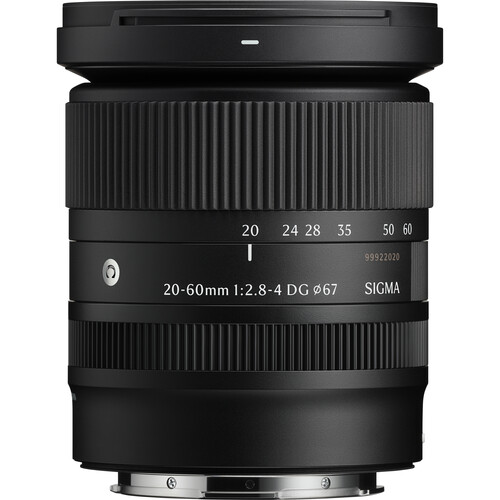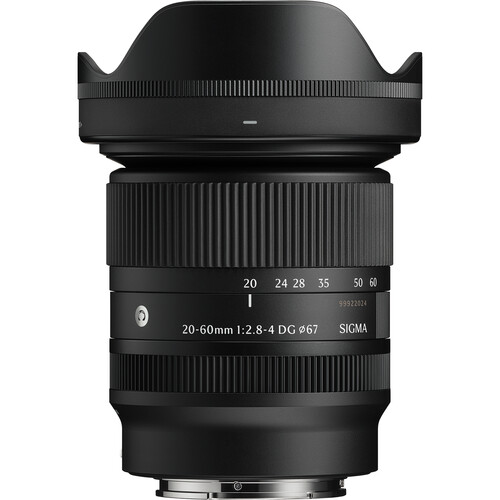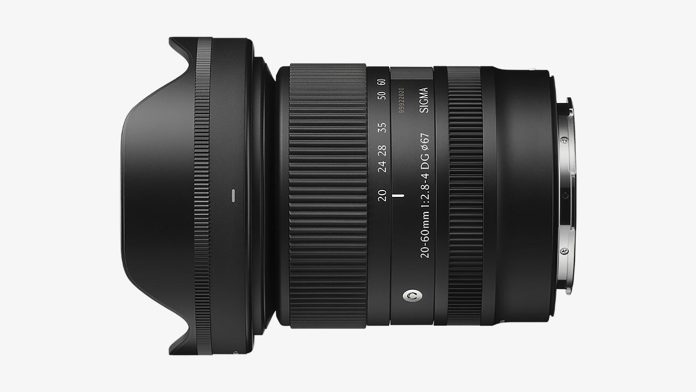
Sigma has announced a new standard zoom for full-frame mirrorless cameras. The 20-60mm F2.8-4 DG Contemporary comes in L-mount and Sony E-mount, and it trades reach at the long end for an unusually wide 20mm start.
Compact design
The lens measures 3.5 inches (88 mm) long by 2.8 inches (72.2 mm) in diameter and takes 67 mm filters. The weight is 13.6 ounces (385 g) in L-Mount and 13.2 ounces (375 g) in Sony E.
For context, that’s roughly half the weight of Sigma’s own 24-70mm F2.8 DG DN II Art, which was already light for its class. This is a lens you leave on the camera.
Optical construction
Sigma built the 20-60mm with 15 elements in 13 groups, including three aspherical elements and three SLD (Special Low Dispersion) glass elements. The design targets flare and ghosting, with strong backlight resistance. The diaphragm uses nine rounded blades.
Focus breathing is suppressed, which matters if you’re pulling focus on video.
Autofocus
Focus is driven by Sigma’s HLA (High-response Linear Actuator) motor. The company claims high-speed, high-precision performance and solid tracking on fast-moving subjects.
Close focus
This is where the lens gets interesting. Minimum focus distance varies across the zoom range, and the shortest isn’t at either end. At 20 mm you can get to 7.9 inches (20 cm). At 60 mm it’s 9.9 inches (25 cm). The closest point is 6.2 inches (15.8 cm) at 28 mm.
Maximum magnification is 1:2.3, or 0.43x, and it lands at 35mm. That’s genuinely close to half-macro, and it beats the Sony FE 20-70mm F4 G at 0.39x.
Aperture
The 20-60mm is not a constant-aperture lens, and the ramp is steeper than the F2.8-4 designation suggests. F2.8 only covers 20 mm to 22 mm. From there, it steps to F3.2 through 28 mm, F3.5 through 37 mm, then F4 from 38 mm out to 60 mm.
That matters for video. Adjust focal length mid-shot and your exposure shifts, and you lose the F2.8 almost immediately after leaving the wide end. Plan around F4 and treat F2.8 as a bonus at 20mm.
Other features
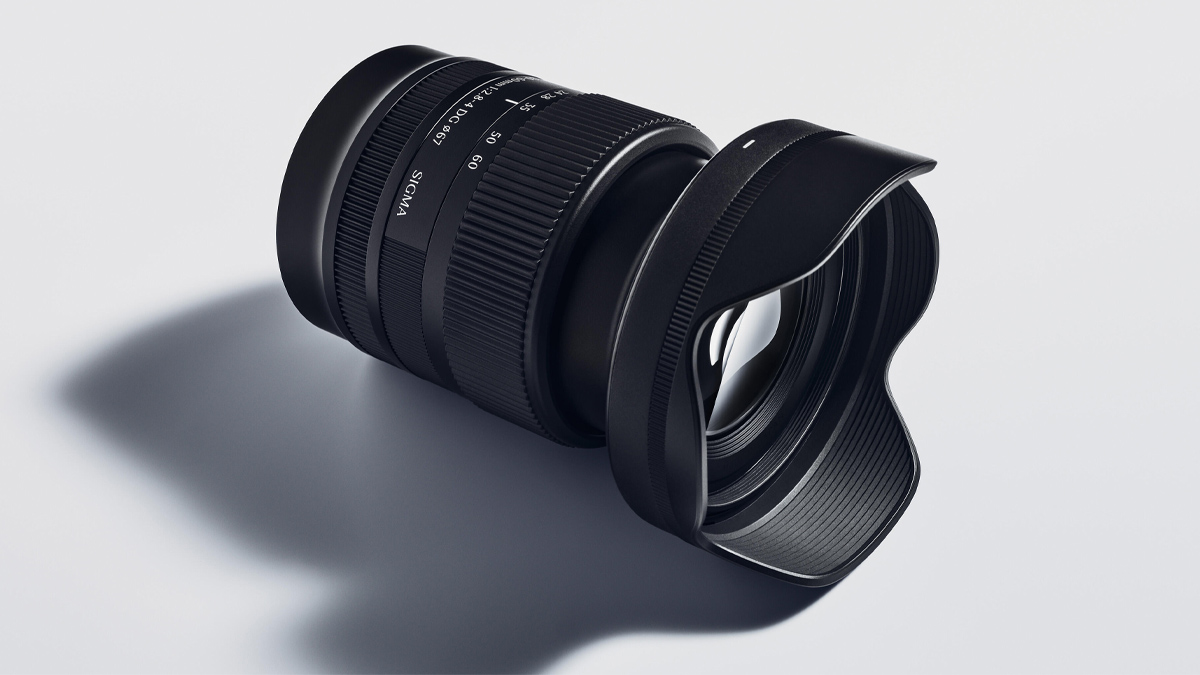
The barrel is dust- and splash-resistant. The front element carries a water- and oil-repellent coating. An LH706-04 hood is included.
What we think
This is a real variation on the standard zoom rather than another 24-70 mm. You give up 10mm at the top, but 20 mm to 24 mm is a bigger jump in field of view than the numbers suggest, and it opens up landscapes, architecture and cramped interiors without swapping to a dedicated ultra-wide.
Sixty millimeters still works for environmental portraits, though it’s short of where most portrait shooters want to be. The near-half-macro capability is the sleeper feature here, since 0.43x at 35 mm covers a lot of product and detail work most standard zooms can’t touch.
The aperture is the honest drawback, and not for the reason the spec sheet implies. Losing F2.8 by 22 mm means this behaves like an F4 zoom most of the time. Sigma clearly chose that to keep the lens under 400 grams, which is a defensible trade for a Contemporary-line lens at this price. Just go in knowing what you’re getting.
Pricing and availability
The Sigma 20-60mm F2.8-4 DG Contemporary arrives October 6 at $849.