
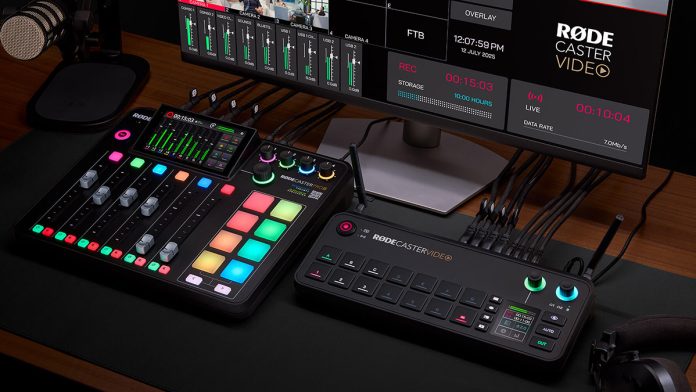
RØDE has released a major firmware update for its all-in-one video production consoles, covering the RODECaster Video, RODECaster Video S and RODECaster Video Core. Version 1.4 turns these consoles into dedicated 4K or HD multi-camera capture and distribution systems. It also brings RODECaster Sync to the entire current-generation lineup.
4K Capture mode
The headline addition is 4K Capture mode, which converts the console into a UHD (3840 x 2160) capture and distribution system alongside its standard switching operation. It handles either 4K30 or 1080p60 feeds.
Each console accepts multiple UHD30 camera inputs over HDMI. That means four inputs on the RODECaster Video, or three on the Video S and Video Core.
Output signal
Every feed can go out as its own NDI (Network Device Interface) stream, which you can route to any NDI-enabled production, streaming or recording system on your network. That makes it a natural fit for OBS and Ecamm Live.
There’s a 4K ISO recording option too. Each source records as an isolated 4K track straight to an external SSD as H.264 or H.265, ready to drop into a separate post workflow.
Reduced features
Pushing that much resolution costs you something. RØDE says several console features are reduced or simplified in 4K Capture mode, including mode switching, multi-camera scene arrangement, keying and media options. All of them work normally in the default Switching mode.
Full HD Capture mode
Version 1.4 also adds a Full HD Capture mode, which runs 60 fps across multiple 1080p feeds.
RØDE describes both as purpose-built throughput modes. Each one points the console’s octa-core engine entirely at capturing and distributing multi-camera video. The full RØDE audio mixer keeps running alongside, with every NDI output available as its own custom mix. When you need keying, graphics, transitions, scenes or direct streaming, you switch back to standard FHD Switching mode.
RODECaster Sync
RODECaster Sync links any RODECaster Video console to a RODECaster Pro II or Duo over a single USB-C cable, so the two work as one audio-and-video studio. That was already possible on the Video Core. Version 1.4 extends it to the RODECaster Video and Video S.
Once connected, the Pro II or Duo doubles as an extra control surface for the video console. You get a nine-channel mixer that takes any input from either unit. Recording, channel processing and custom output routing are all shared, and you can record both video and audio to the RODECaster Video’s drive.
Other new features
The consoles can now export timeline information as OTIO files for Adobe Premiere, letting you rebuild a multi-camera production and fine-tune the edits there. DaVinci Resolve support arrived earlier in version 1.3.
Two smaller additions round things out. The consoles accept audio from any compatible USB webcam. The RODECaster App also gains keyboard shortcuts for Scene Builder, which effectively turns a computer keyboard into a switching interface.
What we think
This is a substantial update. The 4K and Full HD Capture modes turn the consoles into dedicated multi-camera capture and distribution devices, which is a genuine expansion of what the hardware does.
Losing features to handle that resolution isn’t surprising. What matters is that nothing is taken away permanently, since the new modes sit alongside the old ones and Switching mode still works as before.
If you own any of the three consoles, this one is worth installing.
Pricing and availability
RODECaster Video 1.4 is available now. The update is free and works with the RODECaster Video, RODECaster Video S and RODECaster Video Core.


