
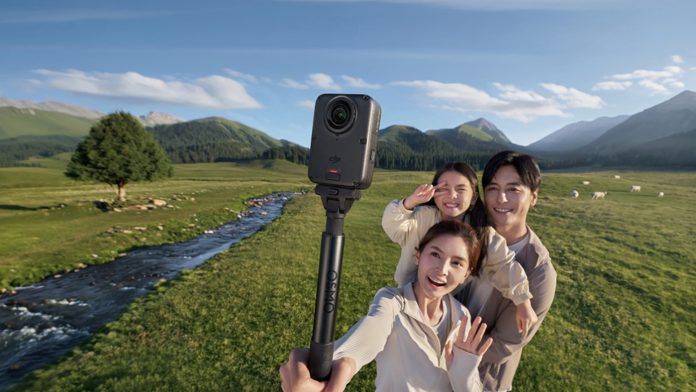
DJI has launched the second generation of its Osmo 360-degree camera. The Osmo 360 II brings a handful of real improvements, most notably 14.5 stops of dynamic range and user-replaceable lenses.
Build
The Osmo 360 II weighs just 6.5 ounces (183 g) and measures 61 x 36.3 x 81mm. It’s IP68-rated and waterproof to 33 feet (10 meters) out of the box, or 164 feet (50 meters) with the optional Invisible Waterproof Case.
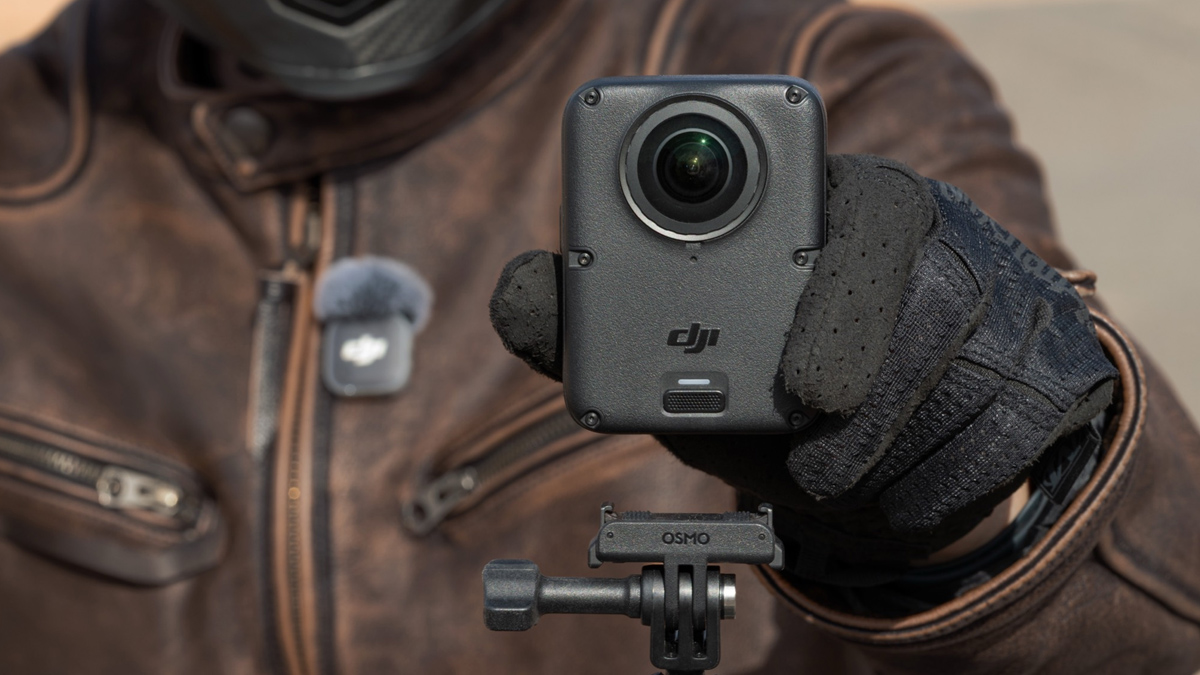
The headline design change is the replaceable lens system. Scratch a lens on a rock and you swap it rather than sending the camera in, with replacement kits selling separately for about €39. Both lenses also carry a hardened coating for better scratch and wear resistance.
A square sensor with one-inch-equivalent coverage
The Osmo 360 II uses a 1/1.1-inch square CMOS sensor, which DJI says is an industry first. The square format delivers the same 360-degree image field as a traditional 1-inch rectangular sensor while wasting far less of the imaging area, and DJI credits that efficiency for both lower power draw and what it calls a massive leap in image quality.
Dynamic range now reaches 14.5 stops, up from 13.5 on the previous model. A new AI SuperNight 2.0 noise reduction algorithm handles low-light work.
Native 8K 60fps video
Large 2.4μm pixels and a faster processor let the Osmo 360 II record native 8K 360-degree video at up to 60 frames per second (fps). DJI claims frames stay sharp and blur-free through hard action like ski jumps.
Slow motion is where the bigger jump lives. The camera shoots 360-degree 4K at up to 240 fps, well past the 100 fps ceiling of the original Osmo 360. D-Log M is available, and every video format now supports 10-bit color.
Audio
A built-in four-microphone array handles wind noise reduction. You can also connect the DJI Mic 3, DJI Mic 2, DJI Mic Mini 2, DJI Mic Mini 2S and DJI Mic Mini through OsmoAudio Direct Microphone Connection, which captures a two-person conversation without a receiver in the bag.
Creative features
Paired with the updated DJI Mimo app, the Osmo 360 II adds intelligent subject tracking. Spotlight Follow keeps your subject centered no matter how the camera spins.
Pano Slow Motion pushes up to 64x, equivalent to cropped 8K at 480 fps, using DJI Studio’s AI frame interpolation in post. Vortex turns a simple swing of the camera into smooth 8K/120 fps wraparound slow motion.
Other features
There’s 128GB of internal storage with 105 GB usable, expandable to 1TB via microSD. A single battery is rated for 100 minutes of 8K 30 fps recording, and fast charging hits 80% in 22 minutes. Worth noting that the 100-minute figure matches the original Osmo 360 despite the larger cell, since 8K60 asks more of the processor.
What we think
This is an evolution, not a revolution. DJI improved a lot without touching the fundamental design, and most of what’s here is welcome. Higher frame rates matter most, particularly the 4K 360-degree slow motion. Better dynamic range and AI SuperNight 2.0 should help in the situations where the original struggled.
Replaceable lenses are the genuinely useful addition. Anyone who has scuffed a 360 camera on a trail knows the alternative is an expensive repair or a new camera.
For a first 360 camera, it’s an easy recommendation. The catch for American buyers is availability. DJI has not announced US pricing or a release date, and its US store returned nothing at launch. This isn’t an outright federal ban on the camera, despite how it often gets described. The Osmo 360 II received its FCC equipment authorization on Dec. 21, 2025, one day before the Covered List cutoff froze new approvals for DJI hardware. What’s missing is DJI putting it on sale here.
Pricing and availability
The Osmo 360 II goes on sale worldwide Sept. 15. The Standard Combo runs €589 in Europe and £509 in the UK, roughly $685 at current exchange rates. The Adventure Combo is €739 and £639.

